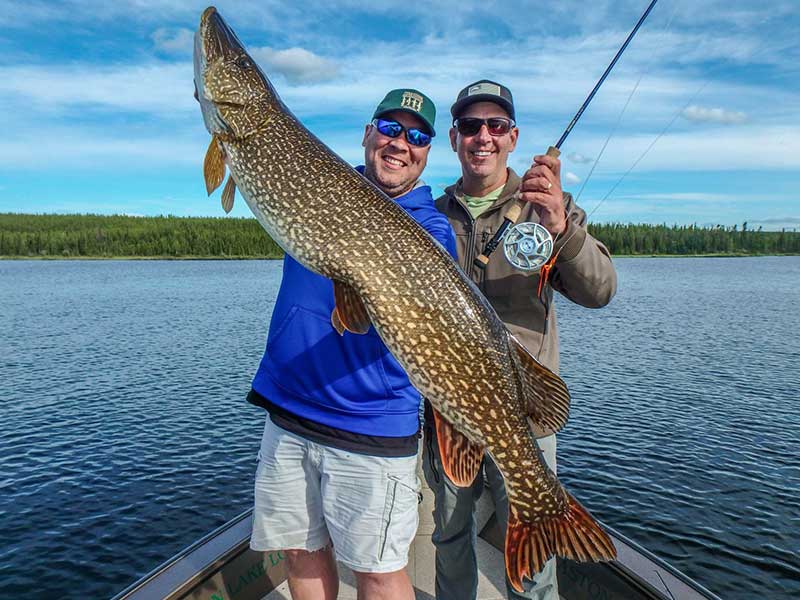

By the time the guides got to know him, Barry was already a legend in his own quiet way. Everyone at the lodge knew him. Everyone loved him. He was one of those rare, genuine souls who made people feel lighter just by being around. Staff members would drift toward him in the evenings, eager to chat, laugh, and hear whatever story he had ready. Many guides would later admit that Barry had taught them as much about fly fishing as they ever taught him. He is that kind of angler—knowledgeable, patient, and exceptionally skilled.
Barry’s history with the region stretched back even further than his time at Wollaston. He often told the story of how he ended up switching lodges. Years earlier, while staying at a nearby camp, his guide had taken him on a grueling journey—hours down a long, “bumpy” river in a battered aluminum boat that seemed to lose a little more structural integrity with every mile. When they finally reached their destination, exhausted and rattled, a sleek, much larger boat was already pulling away.
Barry turned to his nephew Charlie and asked, “What’s the name on the side of that boat?”
“Wollaston Lake Lodge,” Charlie replied.
“Remember that,” Barry said.
And they did. The next year—and for nearly twenty more—Wollaston became their home for the annual pike pilgrimage.
Most guests stayed four days. Some stretched it to eight. But twelve days? That was rare. Barry always stayed twelve. He savored every minute. Anyone walking past his deck in the evening risked being pulled into a long, easy conversation—usually over a rum and coke he insisted on providing. He’d talk about the day’s fish, the weather, the places he’d explored. His Texas drawl pulled people in, and the rum loosened them up. Hours slipped by without anyone noticing. Even the camp dogs wandered over, settling at his feet as if they, too, were part of the gathering.
Barry never lacked company. Some years he brought his son, other years a grandchild, nephew, or his sister Mary. In later years Mary always joined him, who was equally a fixture on the deck in the evening. Guides would often spent four days with Mary, then four with Barry, and always looked forward to both. It was fly fishing from dawn to dusk—big pike the constant goal, with the occasional detour for lake trout before inevitably returning to the hunt.
Even when his family joined him, the rule was the same: strictly fly fishing. And on the days when Barry was alone—at least in theory—he was never truly alone. His friendships with the lodge owners, Mike and Judy Lembke, ran deep. They often hopped in the boat with him for a day on the water. Rocky, the guide manager, joined from time to time as well. Once, Barry even invited Rocky’s teenage son, Race, to come along. That day, Race caught his first-ever 40‑inch pike, on a fly rod. Of course he did. It was strictly fly fishing, and Barry always gave up the bow when he invited a staff member. He wanted others to have their shot at a big fish. That’s who he is.
Barry’s fly selection was another source of endless amusement. Every guide knew the routine. Each morning he’d say, “I want you to grab my fly box, you can pick out any fly you want me to throw, as long as it’s yellow!” Then he’d roar with laughter.
The joke never got old, because the moment the box opened, the truth revealed itself: nearly every fly was yellow and red. Out of a hundred, maybe six weren’t. The rest were Barry’s own creation—a big schlappen Seaducer with yellow feathers, flashes of gold and silver, a red bucktail head, and heavy dumbbell eyes on a stout 4/0 hook.
“I like that I can see it. If it disappears, I set the hook,” he’d say. Simple. Effective. Deadly. Guides saw firsthand how well “Barry’s bloody chicken” worked. Many still used the pattern, and it still continues to crush big pike year after year.

One of Barry’s many Chicken flies drying out
Barry often explained how it all began. When he first came north, he’d been told yellow and red Seaducers were the ticket. The store‑bought versions worked, but they fell apart quickly. “By the end of the day, the bottom of the boat was covered in dead yellow and red Seaducers,” he’d say. So he started tying his own—ugly, durable, irresistible to pike.
One of the most memorable stories Barry ever shared came when someone asked how he got into fly fishing. He told it the same way every time
“Well, when I was a little kid, about 7 years old, I started out with an old split bamboo fly rod, a hook and a bobber. I had to go into the garden and pick the worms myself, but I hated picking the worms. Anyway, I went with my dad and uncle one day, they were fly fishing, small cork poppers, me with in the middle with my worms and bobber. There I was, catching nothing on the worms I had to pick. My dad and uncle were catching lot’s fly fishing with those poppers, and they never had to pick worms! I asked If I could try a few casts with a popper on the split bamboo rod, wearily they said yes. I had watched what those two were doing and tried to copy the motions. Sure enough I started catching bass and bluegill too. That was the last time I picked worms, I hated picking the worms. The idea that I could go and catch fish and never have to pick worms again was what got me into fly fishing!”
That simple childhood aversion to worms eventually shaped an entire family of fly anglers. His kids never had to pick worms either—so long as they learned to cast a fly rod, which they all did, and did well.
But despite all these years of stories, laughter, and legendary pike, this tale, surprisingly, is not, about Barry Austin.
This tale is about Peggy Austin, Barry’s lovely wife.
For decades, Barry made his annual journey north, always joined by family—except for one person. His wife, Peggy. “She is terrified of planes,” he would explain. “She would never come, too afraid to take the flight from Dallas all the way up here.”
And for almost twenty years, that remained true.
Until one day, it wasn’t.
After years of gentle persuasion, encouragement, and reminders about the safety of modern aviation… along came Peggy.

Peggy getting ready to fly in a float plane for the first time.
And in the Austin household, that was a very big deal.
For twelve days—just as he had done for nearly two decades—Barry Austin returned to Wollaston Lake Lodge. But this time, something was different. For the first time ever, his beautiful, petite wife Peggy stepped onto the dock beside him. Her arrival was a moment years in the making, a quiet triumph over fear and a testament to the pull of the place Barry loved so deeply.
The lodge buzzed with excitement. Everyone knew Barry’s easy laugh and generous spirit. Now they would finally meet the woman who had always stayed home, too afraid of the long flight north—until now.
Peggy, unlike the rest of the Austin clan, was a novice with a fly rod. She had spent weeks practicing on the family pond under Barry’s gentle instruction, determined to join her family in Canada and catch pike on the fly. What she lacked in experience, she made up for in heart. She had a devoted husband at her side—one of the finest fly anglers around—and guides who were ready to do anything to make her first trip unforgettable
Peggy’s first pike on the fly would become a story retold for years. On that first day, the boat drifted along a sand flat dotted with weeds and scattered boulders. The water was clear, the summer sun bright, and at the end of the line danced Barry’s famous yellow‑and‑red chicken fly. Barry stood beside Peggy in the bow, not fishing, but coaching—offering soft-spoken advice, pointing out promising pockets where a pike might lurk.
Then came the cast. A perfect one, landing on the flat and drawing the fly back toward a large rock Barry had pointed out. None of them saw the fish—not even in the crystal water—until it happened. As Peggy stripped the fly past the boulder, a small, aggressive pike shot out and inhaled it.
Peggy screamed. “AHHHHH!”
Panic erupted. The strike had startled her completely; all her practice had focused on casting, not catching. Barry tried not to laugh as he talked her through the chaos. Somehow, through the shock and the flurry of movement, Peggy brought the little pike alongside the boat. The guide scooped it up, removed the hook, and just like that—Peggy had her first pike on the fly.

Peggy with one of her very first pike on the fly
The three of them erupted in laughter and celebration. Peggy’s scream became the joke of the day, her panic a badge of honor. Photos were taken, the fish released, and the boat drifted on, filled with joy. It was only day one. Eleven more remained. Peggy was officially off to the races.
Over the next few days, Peggy caught more and more pike. Her casts were short, but Barry was always beside her, offering his hand to help her to the bow, pointing out fish with the excitement of a man sharing his greatest passion with the person he loved most. Peggy’s screams—sometimes of fright, sometimes of delight—became part of the soundtrack of the trip. She landed several beautiful mid‑30‑inch pike, while Barry fooled a few over 40 inches. But the magical 40‑inch mark still eluded Peggy.
Both Barry and the guide rooted for her. It felt inevitable that she would connect with a big one. It was only a matter of time.
On the fourth and final day with their first guide, the weather turned. Scattered rain poured from low clouds, though the wind stayed mercifully calm. The guide worked the tiller, glasses fogged, hood pulled tight, wiping the lenses constantly in hopes of spotting fish. Sight‑fishing was difficult in the gloom, so they worked the structure methodically—shorelines, cabbage beds, ledges—letting the pike find the fly when they couldn’t see them.
The fish didn’t mind the rain. In fact, they were aggressive. Peggy and Barry were putting on a clinic, one fish after another inhaling the yellow chicken. Numbers were high, but size was modest—aside from Barry catching a 42‑inch beauty early in the day. As the hours passed without a big fish for Peggy, the guide began to worry the moment might not come. But the trip wasn’t about inches. It was about Peggy finally experiencing the place that had captured her husband’s heart.
Then, as if summoned by the fishing gods themselves, a shadow appeared.
A large pike cruised past the boat, only four feet from the gunnel, moving quickly from bow to stern on Peggy’s side. Fog clung to the guide’s glasses. It was a miracle the fish was seen at all. There would be no second chance.
“Peggy, make a quick cast back toward me, there’s a good fish right here!”- the guide exclaimed.
Peggy reacted instantly, lifting her line and casting. But the fly landed two feet behind the fish. The guide’s heart sank. Pike rarely turn for a fly that lands behind them. More often, they spook and vanish.
But not this one.
The pike sensed the disturbance, wheeled in a sharp U‑turn, saw the fly, and crushed it.
“SET, SET, SET!” the guide called out.
Peggy strip‑set hard, burying the hook. The rod bent deep. The “brute,” as Barry called the big ones, tore off toward deeper water. Peggy kept the line clear of her feet, gathered slack, and held on as the fish surged onto the reel. Barry placed his hands gently on her shoulders, steadying her on the rain‑slicked bow, guiding her through the fight with calm, loving encouragement.
After several powerful runs, the brute finally came to hand.
There was no doubt—Peggy had her 40.
Barry had landed a 42 earlier, so when the tape stretched to roughly the same mark, the guide squinted through foggy glasses, hoping for just a little more. Maybe it was optimism. Maybe mischief. Maybe both.
“Forty two, and a half!” he announced.
Maybe it was only 42 and an eighth. But it was bigger than Barry’s. Scout’s honor.
Peggy screamed again—this time pure joy. She had her 40‑inch pike, and she had a half‑inch of bragging rights over her husband. Photos were taken, the fish released, and high‑fives cracked through the rain.
On the ride back to the lodge, soaked but glowing, Barry leaned back with that familiar wry smile.
“You know you didn’t have to give her the half inch.”
But of course he did. That’s what good guides do.
The rain never dampened the smiles on that boat. Not for a second.
The time with Barry and Peggy in the first guide boat eventually came to an end. Beginning the next morning, the lovely couple would spend the following four days with another guide. It would have been easy—natural, even—to assume the story of The Pike of a Lifetime had already reached its conclusion. A devoted wife conquering her fear of flying to join her husband on his annual pilgrimage north, learning to cast a fly rod, and topping it all off with a 42.5‑inch brute of a pike. For most anglers, that alone would be the pinnacle of a lifetime on the water.
But the fishing gods were not finished with Peggy Austin. Nor were they done with Barry’s famous Chicken fly.
The details of the next four days blurred with time. Peggy took a day or two to rest at the lodge, letting Barry fish with Mike and Judy. The black flies had gotten to her after the rain, leaving her face a bit swollen, but her spirits never dimmed. Black flies be damned—Peggy was having fun.

Peggy, soaking in the sun at shore lunch
For the final four‑day stretch of their trip, Peggy and Barry were paired with none other than Phil Wiebe—founder of Pikeonthefly.com, longtime guide, mentor, and a man whose reputation on the water bordered on myth.
The story picks up again on a sand flat within sight of where Peggy had landed her 42.5‑inch fish days earlier. The setting was familiar: scattered cabbage, a gentle drop‑off, a slight wind pushing in. Peggy stood in the bow once more, casting steadily while Barry scanned the water for movement. Phil maneuvered the boat with quiet precision, giving her the best possible angles.
Later, every guide at the lodge would ask Phil the same question: Did you know that fish was there?
Phil has earned the nickname “the ninja” among the guide staff. He moves across the lake like a ghost—silent, unseen, yet somehow always in the right place at the right time. His guests catch enormous pike year after year, though no one can ever quite explain how. It’s as if he knows the giants personally, as if he whispers their names and they rise from the depths to greet him. He never brags, never boasts, and carries a sense of humor even drier than Barry’s.
When asked whether he knew that fish was there, Phil simply shrugged and said, “I had no idea that fish was there, it just showed up. I’ve fished that spot for 25 years, never seen one THAT BIG there before.”
Peggy’s cast had been like any of the hundreds—perhaps thousands—she had made so far that trip. Not aimed at a fish, not particularly remarkable, just another steady delivery of Barry’s Chicken fly toward the cabbage edge. She stripped the fly gently—strip, strip, strip—bringing it back toward the boat.
Then, from the depths, a shadow rose.
The yellow fly vanished in an instant. Peggy leaned her entire tiny frame back and set the hook. And immediately, she knew this one was different.
For most fly anglers, a 40‑inch pike is the dream—a true trophy anywhere in the world. Watching a fish like that eat your fly will make your knees shake and your heart pound. Few thrills in fly fishing compare. But a 50‑inch pike? That is something else entirely. That is the realm of legend.
Barry himself has never caught a 50” pike despite decades of trying. Barry does have a 49‑inch fish to his name, caught on a day when Judy Lembke had first raised the fish to her fly before letting Barry take the shot. Even Mike Lembke, who fished Wollaston for nine years before buying the lodge and for more than twenty‑five years after, has caught exactly one 50‑inch pike—and it happened on a day when Barry had invited him to fish together
Barry knows what a truly enormous pike looks like in the water. He has chased them for decades. He has been in the boat with a 50‑inch fish. He wanted one for himself someday, and everyone at the lodge hoped he would get it.
Phil knows the look of a 50‑inch pike too. He has handled more than most anglers could dream of.
When Peggy planted the hook in the corner of this fish’s mouth, its size was immediately obvious. If her 42.5‑inch fish had been a “brute,” this one was something else entirely.
Barry later recalled seeing the fish in the water, then looking at Phil and silently mouthing the words he dared not say aloud: Is that a 50?
Phil looked at the fish, then at Barry, and mouthed back, I think so!
Neither wanted to jinx it. Neither wanted to rattle Peggy. But in that moment, they shared a silent understanding of what was unfolding.
To Peggy, it was simply a very big fish—no number attached. But she felt the weight of it, the pressure, the nerves that swell in the presence of something extraordinary. She looked back and asked, “What do I do?!!”
“PANIC,” Phil replied instantly.
Peggy laughed, the tension breaking like a snapped line. The nerves eased. Phil, meanwhile, had to keep the fish away from the engine, away from the hull, away from every hazard that could end the fight. But his calm, dry humor was exactly what the moment needed.
Peggy steadied herself. Dug in. Prepared for battle.
The pike surged. They kept it out of the cabbage. The knots held. The line stayed tight. The hook never budged. Peggy never wavered. Barry, who had taken Phil’s advice more literally, was panicking on the inside but stayed outwardly calm, hands on Peggy’s shoulders, guiding her through each moment.
Inch by inch, Peggy gained ground. After what felt like an eternity, the fish rose. Phil leaned over the gunnel, reached down, and the fight was over.
Peggy had done the unimaginable.
She had caught the unicorn.

Phil Wiebe holding Peggy’s 50″ Pike, caught on the fly her husband Barry tied, the chicken fly
Just days earlier, she had caught her first pike on the fly. Then she had caught her first 40‑inch fish. And now—now she had landed a pike that would live forever in her family’s lore and in the history of Wollaston Lake Lodge.
She had conquered her fear of flying. She had endured black flies, rain, wind, and waves. She had found her cast, set her hooks, and fought her fish with her loving husband beside her.
That night, more people than usual gathered on the deck of their cabin. More rum and cokes were poured. The story was told again and again, each retelling met with laughter, awe, and joy.
For the first time ever, on the annual Austin family pike pilgrimage, along came Peggy. She made the trip only once—but she made it count. She made memories that would last a lifetime.
And she caught a 50‑inch pike.
No extra half‑inch needed.
Truly, the pike of a lifetime.

Peggy and Barry together, exploring an old, remote Church, on Wollaston Lake. Peggy and Barry still live happily amongst the pecan tress of Texas.
Written by Andrew Marr-pikeonthefly.com
Special thank you to Phil Wiebe and Mike & Judy Lembke who helped with this story.
All photos courtesy of Barry Austin.
Discover more from pikeonthefly.com
Subscribe to get the latest posts sent to your email.